Singing this Stuff
Enough people have asked me how I've learned all these songs and how they can get into singing folk songs
and sea chanteys. I keep wishing for a page online to explain it better than my writing down some titles and resources
on bar napkins or limiting my answers to the time between songs.
So, how did I learn all this stuff, and how can you?
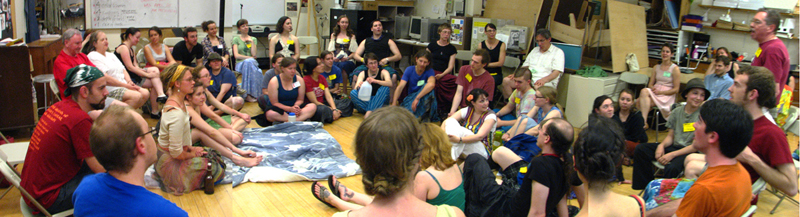
Song Swap at the New England Folk Festival
SHORT ANSWER: I learned it by doing it - listening to people sing and joining in when I felt comfortable... for many years.
MORE HELPFUL ANSWER: Go to a sing and learn the choruses to a couple common songs. Then learn two songs well enough that you can sing them confidently, from memory when there's no one else around. (Two songs, so you have a spare in case someone else sings "your" song before you get a chance to.) Keep going to sings, join in as much as you're comfortable, build on what you know, and maybe lead one of the songs you prepared. Jot down the songs that you particularly enjoyed (the title, or some of their lyrics) so you can look them up online or ask their singer what that song was and where they got it.
There. Now go find a sing.
Finding A Sing
Seattle Region
The Seattle Pub Sing usually happens on third Thursdays at
St. Andrew's Pub (On Aurora, near Green Lake)
Northwest Seaport hosts a monthly chantey sing, usually on second Fridays
The Tavern Shanty Sing usually happens on third Tuesdays at St. Andrew's Pub (On Aurora, near Green Lake)
The Port Townsend Pub Sing usually happens on the third Tuesday of each month
The Olympia Pub Sing usually happens third Saturdays at the Cup of Swords Tavern
In the Northeast
Greater Boston Traditional Song is a facebook group listing Boston area singing events
Northeast Chanteysings keeps a calendar of maritime music events in the northeast (note, this is a yahoo group and you'll need to join to get access to the calendar. You can set it to receive no notifications or receive them only 1/week)
N.E.F.F.A. has it's music festival each April, and other programs throughout the year
Brattleboro, Vermont has a monthly Pub Sing
Other areas of the US
San Fransisco has a monthly chantey sing at Hyde Street Pier
Minneapolis has at least one monthly pub sing at the Merlins Rest Pub
Chicago has a monthly chantey sing and an annual maritime festival
Connecticut's Mystic Seaport has a Sea Music Festival every June and a big chantey sing every January
Washington D.C. has a monthly Shanty Sing at the Laughing Man Tavern
New York has a monthly chantey sing at Snug Harbor
Can't find a sing near you? Send me an email and maybe one of my singing friends will know of one
Some Good Singers of Chantey/Maritime Music

Chantey Sing at the USS Constitution Museum, MA |
|
Some Good Places to Look Up Songs
Some Common Songs
Folk music in general does not have songs that are common everywhere, but sea chanteys do!
Some Common Sea Chanteys
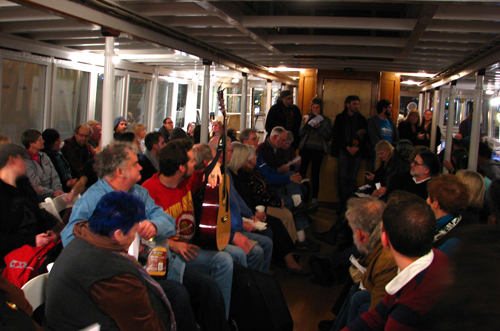
Chantey Sing on board the Virginia V, Seattle |
|
Some Less Common Chanteys That I Wish Were More Commonly Known
More Information & Opinions:
- "Chantey Sing", "Pub Sing", etc. Chantey Sing generally means singing songs about the sea, ships, sailors, working on ships docks rivers barges etc., songs that coordinate work, or anything that sailors were known to sing. Pub Sing generally means singing any song that encourages people to join in on a chorus or refrain. Some sings concentrate on a part of the world, or traditional songs, or... Your local sings may vary
- Who gets to sing, when? If you haven't been to a particular sing before, watch the room for a few songs, or ask someone else. For example: At some sings, anyone can sing a song at any time. At some, the opportunity to sing is passed around the room in order (you can always pass - just say no and let it go to the next person). Some have a moderator who picks people to sing (catch their eye, or introduce yourself during a slow moment or a break). Some have leaders who perform a few in a row before releasing it to the room
- General etiquette. The rules change from place to place, but... Don't lead two songs in a row. The version the leader is singing is the correct version at that moment. If you need to talk during a song, talk as quietly as possible. Be extremely nice to waitstaff. If you want to stomp along, make sure it's a stomp-along sort of song. Remember that leading a song takes courage, so be kind to song leaders as they're leading.
- Different versions. There's always another version out there, another verse, another tune... pay attention to how and what the song leader is singing it at the moment
- Leading YOUR version You don't need to sing every verse of a song! You might not like them all, or they might not all fit your brain, your version, your voice, your feeling, or the specific moment when you choose to sing it (you don't have to lead it the same waty every time!). Make it fit your brain and voice, not the brain and voice of the person or recording you learned it from
- Adding more verses to what someone just finished leading Be careful about this, the person may have omitted a verse because they dn't like it or because it detracts from how they think of the song. If that's the case then adding that verse back in will be unwelcome. So consider whether they left out that verse for a reason, for an effect, or for a vibe.
- Singing from paper. It's better to sing from memory, but singing from paper is better than not singing at all! Point your voice outward rather than into the printed page. Only the song leader should be using paper - everyone else should be paying attention to the song leader (yeah, there are exceptions to this)
- Singing from an electronic device. Same as what I said about reading from paper, with these additional notes: Before you begin, make sure that the version on your device is the same version you intend to sing (check it completely). Turn off the Auto-Lock/Screen Shut-Off/Screen-Saver before beginning so that you don't have to fight your device mid-song. Scroll as you go so the current verse is on your screen and ready if you need it (let the room sing the last line of the chorus without you if you need a moment to scroll and find the next verse)
- Singing trumps talking - usually. If this is a sing where anyone can start a song anytime (see what kind of sing... above) then you don't have to wait for the room to completely quiet down before you start your song; People will only start listening to your voice once you start using it. Just try not to step on someone's announcement or introduction, etc.
- Closing Songs. Some chanteys are often used as a final song to close out the sing. If you don't know the room then be wary of leading Seaman's Hymn, Leave Her Johnny, or Maui
- Playing an instrument while someone else is leading. Some people appreciate it, some don't care, some really don't like it. Be careful and watch for any reaction from the song leader, from any moderator/person in charge, or simply from the people around you
- The Beat or the Words? There are /many/ ways to group and classify maritime songs, but beneath all that is a very fundamental divide:
- When the RHYTHM is more important than the WORDS. If the purpose of the song is to coordinate work then the rhythm is more important than the words. So if you forget a word or a line or a verse, keep the rhythm going with la-la-la if you have to. Don't break the rhythm to apologize or wait until you remember the words, just keep the beat going! Get a room moving on a good rhythm and they'll gladly follow you through whatever you do to keep that rhythm going and the energy strong! Sailboat Malarky, Liverpool Judies, Blackbird Get Up, Old Man Pickin On a Banjo, General Taylor, Maui, Boney was a Warrior, Tilbury Town... they each have a powerful beat that drives them along
- When the WORDS more important than the RHYTHM. If the purpose of a song is less about coordination and more about carousing/relaxing/insulting/whatever then the rhythm doesn't need to be constant or rule over the words. Ballads, forebitters, and other types of off-work songs are more concerned with telling a story or setting a scene or making fun of something. Row On, Molly Mauk, Shove Around the jug...
- When you forget or mix up the words. Yeah, that happens to us too!
- If you're only sailing or only singing, you're missing half the story. There're things you can only learn about these songs by working to a steady rhythm, and there're things to learn about work that you only get from singing in a steady rhythm!
- If you need a help (or a good kick in the pants) to get going. Most of us have needed that at one time or another. One option is to find an established singer to back you up, to introduce you, create an opening for you, or simply to throw you out of the nest (you wouldn't be the first)
- Singing versus performing Performing a song for people is different from singing it with them. For example, if you're performing, you might sing fewer choruses, you might play with the tempo, you might have specific instrumental breaks, you might ornament your notes without thinking about whether others can sing along. To sing with people, you want to make it as easy for them to join in without losing the beauty of the song. You might have choruses or refrains at slightly different places than the version you learned from, you might use different ornamentation that makes it easier for people to sing along, you might
- My voice isn't loud enough to be heard The room wants you to succeed (in fact, they came for this!). When you start singing, the people immediately around you will give you their attention and this will spread around the room. If someone else starts a song before that happens, the people around you now know you have a song and when the current one is done, they can tell the room, "Hey, song here!"
- Is louder always better. No. Match how you sing to how the leader is leading the song, and to the acoustics of the room. This isn't always easy, so remember to keep your ears open while you sing and adjust as you go!
- Be aware of what words meant then and what they mean now The meaning and also the acceptability of words changes across time and from place to place. Are there words or concepts in the song you love that are bigoted or hurtful? If so, can you change or omit those words or verses without doing the song harm? Or can you find a time and place to sing it when the room will understand the original place of the song. You aren't necessarily there to defend the song, but you are choosing when and where to sing it. Choose wisely! MEANWHILE, AS A LISTENER, if someone else sings a song that you take issue with, consider whether they know the issue that makes the song questionable to you when you discuss it with them. They might not know, they might have a different understanding or experience of the words/concepts in question, they might know but not have a better alternative.
- Is it "Chantey" or "Shanty"? It only matters when you're not singing
- If this all seems like a lot to deal with. Then ignore it and go find a sing
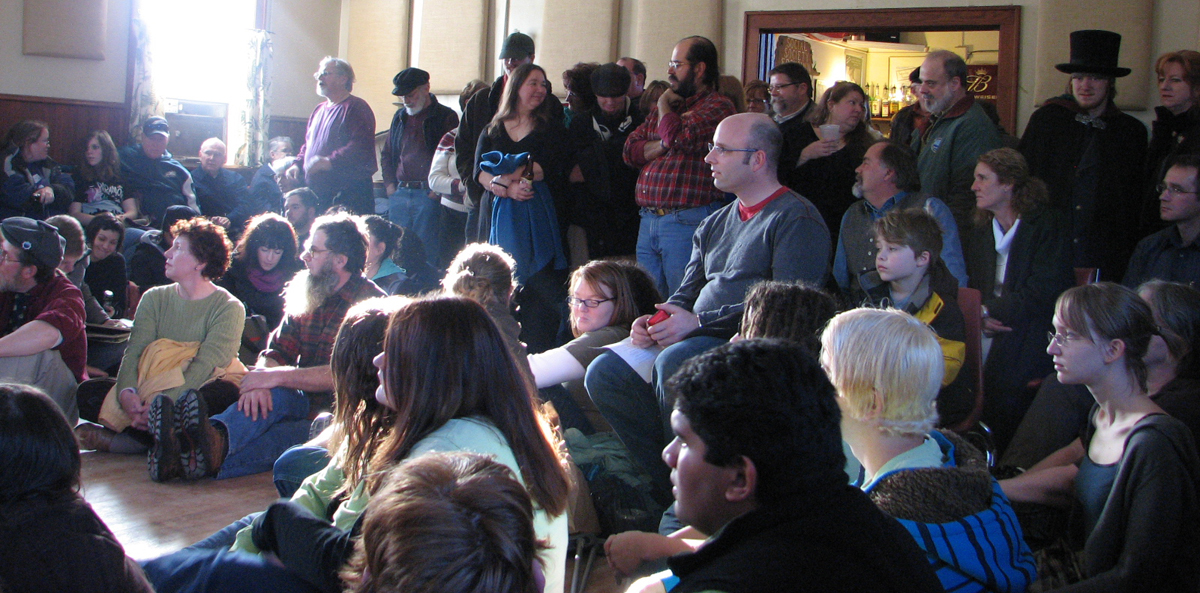
Sing in Mystic, CT
Main Page
Language/Logistics
Resumé
Writings
Calligraphy
Theatre
Music
Wushu
Photo Galleries
Contact
This page was designed by and belongs to David Kessler -
All Rights Reserved.